
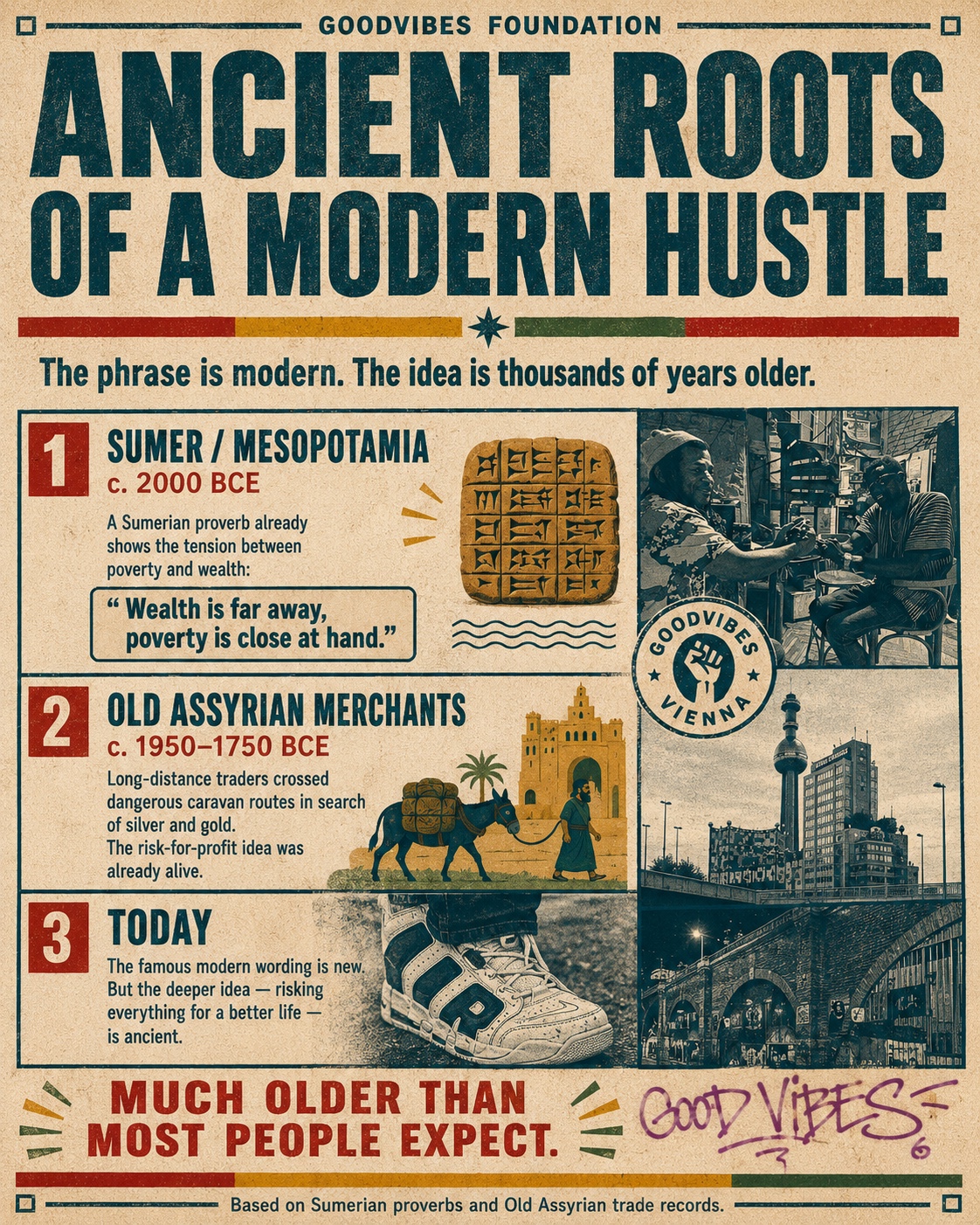
The phrase “get rich or die trying” sounds like it belongs to our era — rap lyrics, movie posters, hustle culture. But the underlying idea? That’s been with us for thousands of years. People have always thought about wealth, poverty, risk, and the dream of a better life. The wording is new. The instinct is ancient.
So let’s trace it back — not to claim some literal origin, but to feel how deep this human impulse really goes. Because when you look at get rich or die trying ancient roots, you find something surprisingly familiar.
Sumer / Mesopotamia — c. 2000 BCE
Thousands of years ago, Sumerian scribes were writing down proverbs — little nuggets of everyday wisdom that people actually lived by. One of them goes: “Wealth is far away, poverty is close at hand.”
Read that again. It’s a four-thousand-year-old acknowledgment that prosperity feels distant, fragile, hard to reach — while poverty is always right there, breathing on your neck. That tension, between what you want and what’s pressing in on you, is the same emotional space where “get rich or die trying” lives today. Nobody is saying this proverb is the origin of the modern phrase. But the mindset? Already fully formed.
Old Assyrian Merchants — c. 1950–1750 BCE
A few centuries later, merchants from the city of Ashur were doing something that feels remarkably modern: they were running long-distance trade operations. These weren’t casual traders. They loaded donkeys with tin and textiles, sent them on weeks-long caravan journeys across the Anatolian plateau (modern-day Turkey), and set up a whole network of trading colonies — the most famous at a place called Kültepe (Kanesh).
What were they after? Silver and gold. They accepted distance, bandits, weather, and the very real possibility of losing everything — because the payoff was worth it. Families invested. Partnerships formed. Contracts were written. Some merchants made fortunes. Others lost their shirts. This is one of the earliest documented examples we have of people consciously accepting serious risk in pursuit of profit. Not the phrase itself — but the whole philosophy behind it, playing out in clay tablets instead of headlines.
Today
“Get rich or die trying” is modern wording. Nobody in ancient Sumer said it. No Old Assyrian merchant carved it on a tablet. But the deeper human idea — risk a lot for the chance at a better life — that’s been running through us for four thousand years. The language changes. The hunger doesn’t.
Good vibes can be light, but they can also go deep. Sometimes the most modern-sounding ideas have roots buried thousands of years in the past.
What other modern sayings would you like us to trace back through history? Drop them in the comments — we love a good rabbit hole.
Sources: The Sumerian proverb is drawn from the Electronic Text Corpus of Sumerian Literature (ETCSL). The Old Assyrian merchant context draws on the Metropolitan Museum of Art’s material on Old Assyrian trade and the Kültepe (Kanesh) tablets.
Leave a Reply