
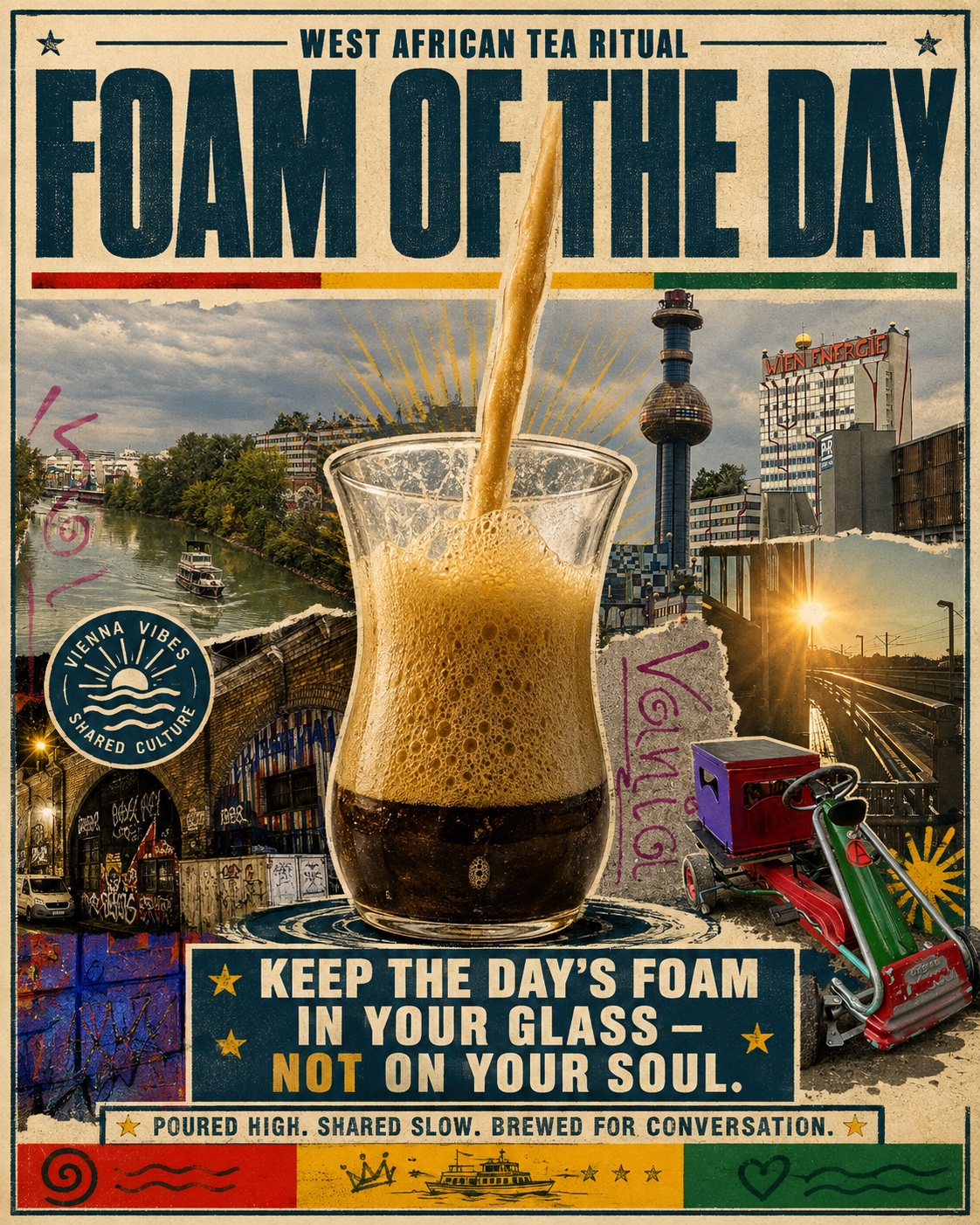
West African tea ritual Vienna — three words you might not expect to meet in one breath, and yet here they are, folded together in a single poster like sugar dissolving into a small glass of tea. The artwork doesn’t claim to document any one ceremony. It does something braver: it imagines a meeting point, a place where the slow, generous choreography of West African tea tradition brushes up against the gravel-and-goldstone rhythm of Vienna, and lets the two talk.
That conversation is the whole point. Tea, in the cultures the poster draws from, is rarely a private drink. It is an appointment with other people. It is poured high and slow, passed around, argued over, laughed over. Vienna, for its part, has its own long romance with coffee-house lingering — the famous unhurried glass of water beside the cup. The poster notices that these two instincts belong to each other. Both cities, both traditions, both gestures say the same thing: sit down. Stay. The foam on top of the glass is not decoration; it is the visible sign of time well spent.
A River Runs Through Both
Look at the poster long enough and a river emerges — or rather, rivers plural, braided into one. The Danube is Vienna’s great grey-blue artery, the water the city has always leaned against. But water carries meaning in West African tea culture too: the kettle, the steam, the patience of waiting for a boil. The poster lets these currents run together, so you can’t quite say where one river ends and the other begins. That ambiguity is the artwork’s quiet thesis. Shared culture Vienna is not a slogan on a wall; it is something that happens in the overlap, in the water two traditions both call their own.
Railways, Facades, Street Texture
The visual language is unmistakably urban. Railway lines cut across the composition like strings being plucked — the trams and rails that stitch Vienna together, and the long-distance lines that carry people, recipes and memories across continents. Behind them rise the facades: the worn grandeur of Ringstrasse stonework, the honest grid of a council-block window, the patina of a street corner that has seen a hundred years of footsteps. It is this texture — cracked, layered, lived-in — that keeps the poster grounded. Nothing here is a postcard. Everything has been touched.
And into that texture the poster sets its tea: glasses glowing amber, hands reaching, steam curling into the architectural lines until the city itself seems to breathe. Tea culture in Vienna usually means melange and marble tables; this image widens the frame, suggesting that the city’s tables have always had room for more glasses than one tradition can fill.
The Art of Slowing Down
What the poster is really selling — if it is selling anything at all — is deceleration. A proper tea round cannot be rushed. The water must boil, the leaves must steep, the pour must be high enough to raise the foam, and the first glass is often the strongest, saved for the guest who matters most. You cannot hurry that and still have it mean anything. Against the velocity of the railway and the hum of the street, the tea glass is a small act of resistance: a pocket of time carved out and offered to whoever is sitting with you.
That is the shared culture the image keeps circling back to — not a fusion of symbols for its own sake, but a shared pace. A city that knows how to linger, meeting a tradition that insists on it. Keep the day’s foam in your glass — not on your soul. The line reads like a toast, and like all good toasts it works in both directions: take your time with the small pleasures, and don’t let the day’s noise settle on you as sediment.
Pour Another Glass
Ultimately the poster is an invitation, not an argument. It doesn’t ask you to choose between a Viennese café chair and a West African tea stool; it suggests you might need both, and that the people around you need them too. So the next time the afternoon starts to foam over — deadlines, timetables, the general fizz of the city — consider the alternative the image proposes: a glass, a pour, a conversation that goes nowhere in particular and takes its sweet time getting there. Pull up a chair. Someone always has room for one more glass, and the best conversations, like the best tea, are never rushed.
Leave a Reply